THEMES
- A Centeranian's Inner Thoughts (27)
- Chid labour (17)
- Confucius teachings (9)
- Do they have a heart or a soul? (52)
- Elderly Health and other issues (36)
- Elderly Humour (39)
- General Humour (33)
- Hobbies and interests (32)
- Thoughts and Reminisces (320)
Saturday, April 28, 2012
Robbed off their childhood!
Saturday, March 3, 2012
Of Zimbabwe's 1.3 million orphans, some 100,000 are living on their own in child-headed households!
According to a 2010 UNICEF report, 13% of Zimbabwean children are engaged in child labour (which the International Labour Organization (ILO) defines as work that is mentally, physically, socially or morally harmful to children and that interferes with their schooling). In the capital, Harare, the figure is closer to 20%.
A study of child labour in Zimbabwe conducted by the Ministry of Labour together with international and local partners including ILO and UNICEF, released in June 2011 concluded that "the prevalence of the worst forms of child labour is on the rise and cause for concern." The report identified poverty as the main driver of children being employed, along with "the breakdown of the family unit due to HIV and AIDS, as well as the inadequacy of the social services delivery system."
According to UNICEF, of Zimbabwe's 1.3 million orphans, some 100,000 are living on their own in child-headed households. Many such children are forced to leave school and find work as street vendors or labourers on tobacco farms, tea and sugar plantations, and in mines in order to support younger siblings.
PLEASE READ FULL ARTICLE ZIMBABWE: Child labour on the rise
Monday, November 21, 2011
One million children work with mercury everyday!

Yet the one million children around the world engaged in artisanal gold mining work with it every day.
Please read full article: Take mercury out of children's hands
Image credit to http://photo.net
Tuesday, October 25, 2011
Children forced to do hard labour, abused and are usually not paid
The documentary brought to light the issue of child labor and human trafficking on the cocoa plantations of Africa. These plantations grow and harvest the cocoa beans for big name chocolate companies such as Nestlé.
The film starts with its two film makers doing their own investigation by journeying to the western coast of Africa to the country of Mali. This is where children were rumored to be smuggled from and transported to the Ivory Coast.
Their detective work led them to find that Mali was trafficking children at bus stations, by bribing them with work and money or simply kidnapping them from villages. They are then taken to towns near the border such as Zegoua, where another trafficker transports the children over the border on a dirt-bike via back-roads, where they are left with a third trafficker who then sells the children to plantations. Ranging from age 10 to 15, these children are forced to do hard labor, physically and sexually abused and are usually never paid. Most of them stay with the plantation until they die, never seeing their family again.
The chocolate industry is marred with child slavery!
Please read full article: The dark side of chocolate
Picture credited to http://www.treehuggers.com/
Sunday, June 19, 2011
One in six children in the world engaged in child labour!

source: http://www.fotosearch.com/
How many of us know the significance of 12 June? International Labour Organization (ILO) has declared 12 June as the World Day against Child Labour. Yet, that the day is not recognized to the extent of less meaningful days like Valentine's Day.
The worst place in this respect is sub-Saharan Africa, in which one in three children is engaged in child labor, representing 69 million children. In South Asia, another 44 million are engaged in child labor.
Monday, December 6, 2010
Their lost childhood
Picture credit: http://www.bigpicture.in/
Picture credit: http://www.lightstalkers.org/
Picture credit: http://www.guardian.co.uk/- Globally, 218 million children are child labourers
- 126 million of these children are engaged in hazardous work
- 73 million working children are less than 10 years old
- Every year, 22,000 children die in work-related accidents
- The largest number of working children-122 million-are in the Asia-Pacific region
Sunday, July 18, 2010
Child labourer found chained in Delhi eatery, rescued

The rescued boy said: "I was working in this dhaba for the last three months. One day the dhaba owner accused me of stealing Rs.50,000 from his home and started torturing me physically.
"A fortnight ago, he decided to chain me. I could move in the radius of one metre only and worked for more than 15 hours a day with hardly any protection from the cold. Police personnel kept coming to the dhaba, but did nothing to rescue me. Even people saw me like this everyday but nobody did anything," he added.
For more information, please read http://sify.com/news/child-labourer-found-chained-in-delhi-eatery-rescued-news-national-kbht6eieehj.html
Child labor is a human rights issue of immense sensitivity. Child labor is considered exploitative by the United Nations and International Labor Organization. “States recognize the right of the child to be protected from economic exploitation and from performing any work that is likely to be hazardous or to interfere with the child’s education, or to be harmful to the child’s health or physical, mental, spiritual, moral or social development.” - quoted from http://www.childlabor.in/
Saturday, May 22, 2010
Child soldiers: victims or assailants?


The persistent violators include Abu Sayyaf, the New People’s Army and the Moro Islamic Liberation Front (MILF), three insurgent groups that are active in the Philippines; Myanmar’s national army, known as Tatmadaw Kyi, and the rebel Karenni Army and Karen National Liberation Army; The Revolutionary Armed Forces of Colombia (FARC) and the National Liberation Army (ELN); in Congo, the national army (known as the FARDC) and the rebel Congress for the Defence of the People (CNDP), Democratic Forces for the Liberation of Rwanda (FDLR), Nationalist and Integrationalist Front (FNI), the Lord’s Resistance Army (LRA) and various militias that are known as the Mai-Mai; in Sudan, pro-Government militias in Darfur and the southern-based Sudan People’s Liberation Army (SPLA); in Somalia, the Transitional Federal Government (TFG); the Afghan National Police; the rebel Convention of Patriots for Justice and Peace in the Central African Republic (CAR) and Somalia’s Hizbul Islam militia.
Please read full article : http://www.scoop.co.nz/stories/WO1005/S00397.htm: UN identifies most persistent users of child soldiers in armed conflicts
Child Soldiers - Victims or Assailants?
The answer is both. Their childhood is snatched away, separated from the love of their families, away from school, away from friends, turned into a killing machine. Brainwashed, at times drugs are freely distributed, under the influence alcohol, the mind confused reality distorted, threatened with loss of life, loss of his family unless he or she performs as ordered. Life becomes living hell and the child begins to not only fight in combat, but kill in ways that were unimaginable a few months earlier. Child Soldiers - are both Victim and Assailant.
Images credit to digitaljournal.com
Sunday, May 2, 2010
218 million children involved in child labour world wide!
Photo credit to National GeographicGlobally, 1 in 6 children work
218 million children aged 5 - 17 are involved in child labor world wide
126 million children work in hazardous conditions
The highest numbers of child laborers are in the Asia/Pacific region, where there are 122 million working children
The highest proportion of child laborers is in Sub Saharan Africa, where 26% of children (49 million) are involved in work.
Saturday, March 27, 2010
An estimated 218 million children are involved in work around the world!


An estimated 218 million children are involved in work around the world.
126 million work under the worst forms of child labour.
More than one million children are employed in the cocoa farming sector in West Africa.
Between 200,000 and 800,000 children under the age of 18 are trafficked each year in West Africa alone.
Thursday, December 24, 2009
The hazardous nature of child labour!

The assessment found that child labour continues to exist in mining and that children are involved in all aspects of the production chain as well as in informal sector stone crushing (quarrying). Children, some as young as seven years, carry out support functions in the mining areas such as fetching water, preparing and selling food, and, in some instances, in the actual mining operation. It provides clear evidence of the hazardous nature of many of the children's tasks; their exposure to toxic substances and extreme heat, lifting heavy loads, working long hours and working at night.
Thursday, December 17, 2009
If you think you are deprived...
Hands of 8 year old Munna working in a rickshaw parts factory! He works 10 hours a day and gets USD8 equivalent a month! Picture from http://www.zoriah.net/blog/
13 year old Islam in a silver pot making factory. He has been working here for 2 years, under very hazardous conditions! Picture from http://www.zoriah.net/blog/
Children at a brick crushing factory. Picture from http://www.zoriah.net/blog/
An 11 year old in a silver pot making factory in Dhaka. He had been working in this factory for 3 years, getting the equivalent of USD10 a month. Picture from http://www.zoriah.net/blog/
A young labourer making metal components in a factory in Dhaka, Bangladesh . Picture from http://www.zoriah.net/blog/
7 year old Jasmine collecting rubblish from a rubbish heap on a cold winter morning in Kajla to support her family! Picture from http://www.zoriah.net/blog/
Child selling balloons in the streets of New Delhi. Picture from http://www.sadashivan.com/
n children under the age of sixteen working around the world—150 million of those in the most harmful industries.Thursday, November 5, 2009
Child labour is simply the single most important source of child abuse in the world


- Child labour remains a serious problem in the world today.
- According to estimates by ILO, the number of working children between the ages of 5 and 14 is at least 120 million.
- The majority of the children are in developing countries in Africa, Asia and Latin America. But pockets of child labour also exist in many industrialized countries.
- Numerous children work in occupations and industries which are plainly dangerous and hazardous.
- Working children suffer significant growth deficits compared with children in school: they grow up shorter and lighter, and their body size continues to be smaller even in adulthood
- Many working children are exposed to hazardous conditions which expose them to chemical and biological hazards.
- Large numbers of working children work under conditions which expose them to substances with long latency periods -- for example, asbestos -- which increases the risk of contracting chronic occupational diseases such as asbestosis or lung cancer in young adulthood.
- Children in certain occupations are especially vulnerable to particular types of abuse. For example, many studies confirm that child domestic workers are victims of verbal and sexual abuse, beating or punishment by starvation.
- Child labour is simply the single most important source of child exploitation and child abuse in the world today.
Information above from http://nird.ap.nic.in/clic/Rrdl12.html
Pictures from flickr.com, bized.co.uk, news.everyclick.com. instablogs.com
Monday, August 24, 2009
More on child labour
Saturday, August 22, 2009
The recruitment of child soldiers still widely practised by the Burmese army
Pic above: A Burmese child soldier, not Htun Htun OoSunday, August 9, 2009
One in six children in the world are engaged in child labour!


Pictures above from stolenchildhood.netMonday, October 20, 2008
Domestic Child Labour in Africa


When my master brought me from the village, he said that I will show that I deserved to go to school by proving my hard work at home. I was bent on going to school so I put my heart into everything I was commanded to do. I Swept, cleaned, washed, mopped, ironed, and fetched water from a public tap, two streets away, to fill the drums and basins in our house.
In-between these chores I had to go out and hawk sachets water in traffic and in the streets of the ghetto. I slept last and woke up first. I didn’t eat with my master, his wife and his children at table, I ate a small portion of food on the floor at the back yard, after they had all eaten. Sometimes I could not work because I was always hungry, but I had to work otherwise knocks and the Koboko cane will descend on me.’ An 8 year old Togolese househelp narrated.
‘After 3 years, my master registered me in a community school down the street. It was more like a place where street children passed time, the teachers hardly came to class. My chores and task were still a problem but I managed to deliver, so as to avoid any problem with my master or his wife. I liked school, I wanted to learn but I hardy had time to review my school work or do assignments and when I did poorly, my master or his wife would beat me like a thief. Sometimes I thought of running away, but to where? I wanted to go back to my mother, but how do I tell my uncle that, when the last time I asked about my mother, I was given the beating of my life, called an ingrate and denied food for two days. I wasn’t doing well at school, I wasn’t happy at home, I missed my mother, but I couldn’t do anything about it. All my mother knew was that her son was in the city and was in school, and will be a big shot.’
Read the complete article: http://en.afrik.com/article14712.html
Our Father's 100th Birthday celebration on 24 July 2011
I am 100 today!
Sister Wan Lan in her splendorous Kebaya nyonya
Zuraida, my Secretary who was with me for 6 years when I was still working in the Government, accompanied by her son
My sister Wan Lan on the extreme left standing with me and my closest friends of several decades (Meilina to my left, Esah sitting left and Norhayati sitting right)
Tan Sri Arshad and Tan Sri Shahrizaila arriving for the reception
Brother-inlaw Ching
Nephew Meng, his girlfriend Jane, Sister Wan Lan and good friend Ivy helping out with guest registration
Offering tea to grandfather Woon Sang Chew, as a mark of love and respect
My good friends Prof Noor Hadjar from UiTM and Hearry from MAS
The entrance to the hall
me in the middle and cousin in law Anita Woon
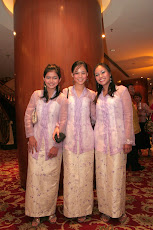
Fedelia and her best friends, Yin Lee and Amalia, the three pretty flower girls
Daughter Fedelia in a pensive mood
The main Table
The pelamin
Whimsical flower girl niece Sara
Nephew Meng and girlfriend Jane
Good friend Wan Zawiah's daughter Nadia contributing a song
My three children L-R: Second son Farouk, only daughter and youngest Fedelia and elder son Feris